I ran a direct mail campaign for my own website design service, which is mostly an online business, and walked away with 50 leads from a $500 ad cost. Of those leads, 60% converted into paying clients.
I was just as surprised as you probably are right now.
But that result did not happen by accident, and it does not happen for every business. Direct mail can work exceptionally well, or it can quietly drain your budget without producing a single phone call.
The difference usually comes down to your audience, your offer, and how you execute the campaign.
Here is how to figure out which side of that line your business falls on.
Which Businesses See the Best Results From Direct Mail?
Direct mail tends to work especially well for local service businesses. Dentists, plumbers, home remodelers, pet care businesses, contractors, and similar companies all have something important in common: they serve customers within a defined geographic area.
That geographic overlap matters.
If you operate in McAllen, Harlingen, Edinburg, Rio Grande City, or anywhere else in the Rio Grande Valley, the person receiving your mailer can actually become your customer.
That makes direct mail especially interesting for businesses that want to reach specific neighborhoods, ZIP codes, cities, or service areas.
Pure e-commerce businesses are a different story. Without a local connection or defined service territory, direct mail may have a harder time delivering the same return it can provide for businesses with a real community presence.
The Biggest Mistake Business Owners Make With Direct Mail
One of the biggest mistakes I see is treating direct mail like a business card.
The owner puts their logo at the top, adds a list of services, includes their phone number, and sends it out.
There is one major problem: you have not given the person receiving it a reason to do anything.
A good direct mail campaign needs an offer.
Instead of:
Professional Roofing Services
Residential & Commercial
Call Today
Give the customer something specific:
McAllen Homeowners: Get a Free Roof Inspection This Month
Now there is a reason to respond.
Your offer does not necessarily need to be a massive discount either. It needs to be specific, relevant, and valuable enough to get someone’s attention.
One audience. One offer. One clear call to action.
That simple structure can make the difference between a campaign that generates leads and one that goes straight into the trash.
A Real Campaign That Proved the Formula Works
The campaign that surprised me most was my own.
I offered $200 off website design specifically for new McAllen customers.
That was it.
One geographic area. One audience. One offer. One result to measure.
The campaign cost me $500 and generated 50 leads. Around 60% of those leads converted into paying clients. Since most of my website services start at $650, the return made sense, especially considering that website design is primarily an online service.
The lesson is not that every business should offer $200 off.
The lesson is the structure behind the campaign.
Pick one type of customer. Create an offer specifically for that customer. Give them a clear reason to respond.
That framework can be adapted across industries.
Is Direct Mail Worth Testing for Your Business?
Here is one of my favorite ways to think about it:
If you could put an advertisement on someone’s refrigerator for the next three months, what would you want it to say?
More importantly, what would you want that person to do after seeing it?
If you cannot answer those questions, your campaign probably is not ready yet.
Direct mail can be particularly useful for:
Recurring services, such as dental cleanings, lawn care, pest control, and other services customers need repeatedly
High-value purchases, such as roof replacements, bathroom remodels, pools, HVAC systems, and other larger projects
Market testing, where a business wants to measure demand in a particular city or neighborhood before making a larger investment
That last use is one that I think more businesses should consider.
I have worked with a pet cremation business in South Texas that uses direct mail to test different cities before deciding where to open its next office.
Instead of guessing which city has the most demand, the business can run campaigns in different markets and compare the responses over several months.
The market starts giving you the answer.
That is a completely different way of thinking about direct mail. The mailer is not only advertising. It can also become a market research tool.
What Do Direct Mail Response Rates Actually Mean?
Industry benchmarks can be useful, but response rate by itself does not tell you whether a campaign was successful.
What matters more is what those responses are worth to your business.
For example, imagine spending $500 on a mailing and getting three new customers.
That might sound unimpressive if you only look at the number of responses.
But if each new customer generates $1,000 in revenue, you spent $500 to generate $3,000 in new business.
That is a very different conversation.
Instead of obsessing over response rate alone, I would pay attention to:
Cost per lead
Cost per acquired customer
Average sale
Customer lifetime value
Total revenue generated
Return on ad spend
This is also why direct mail is usually easier to justify for businesses with higher-value customers.
If your average customer is worth $25, your economics are very different from a contractor whose average project is worth $15,000.
Why the Offer Matters So Much
When a direct mail campaign performs poorly, it is easy to blame the medium.
“Direct mail doesn’t work.”
Sometimes that is true for a particular business or market.
But sometimes the real problem is what was mailed.
A beautiful postcard with no compelling reason to respond is still just a beautiful postcard.
Your offer needs to answer the question every potential customer is silently asking:
Why should I care about this right now?
That might mean:
A free estimate
A complimentary consultation
A bonus upgrade
A limited-time package
A new-customer offer
A free assessment
An exclusive neighborhood promotion
The right offer depends on the business.
The goal is not always to discount your service. The goal is to make taking the next step feel worthwhile.
Why Direct Mail Format Matters More Than Most People Expect
Think about what happens when you open your mailbox.
There are envelopes, bills, letters, advertisements, catalogs, and smaller postcards competing for your attention.
A thin mailer can disappear into that pile very quickly.
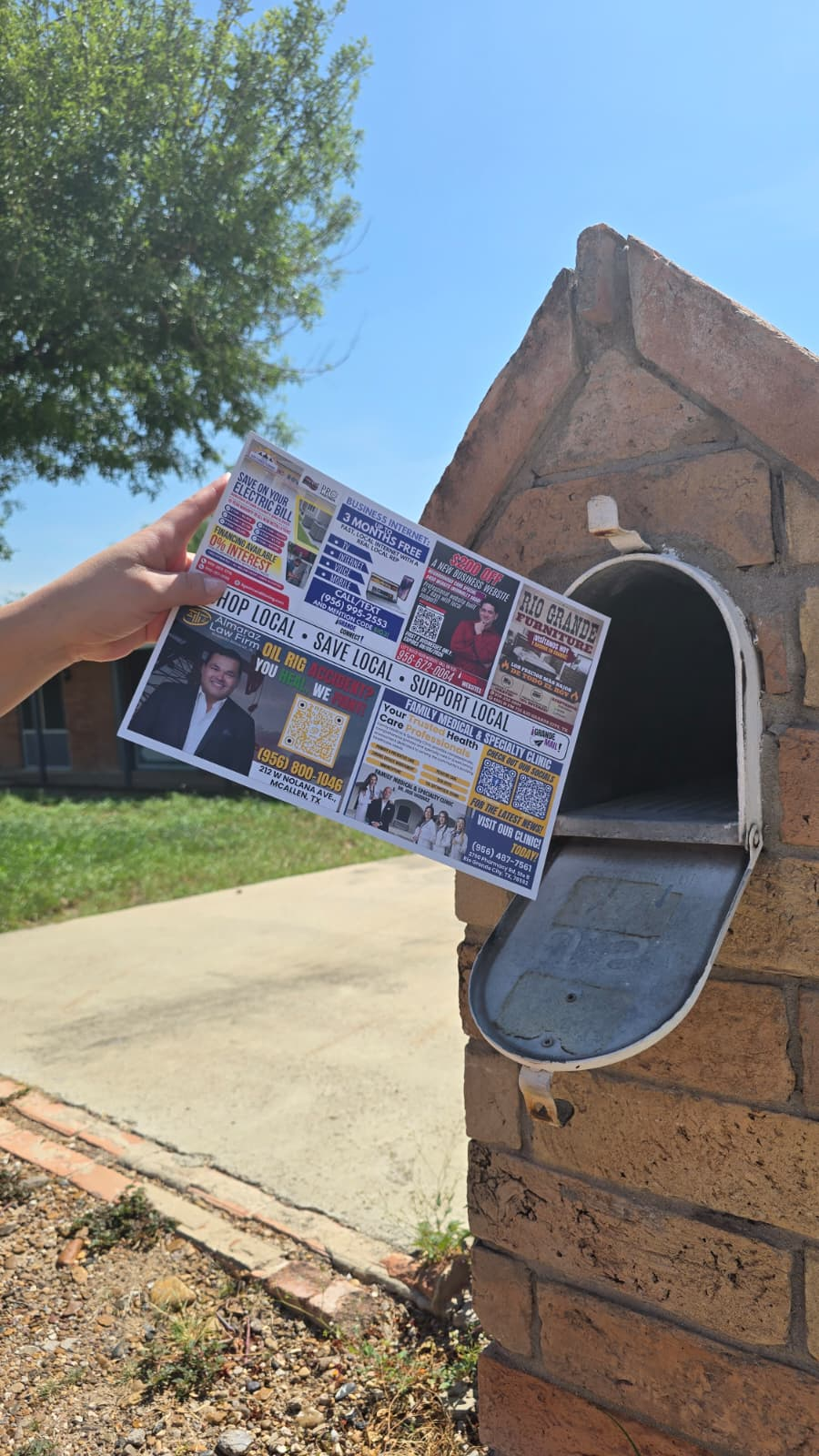
A jumbo 9×12 postcard creates a different experience. It is large, physical, and difficult to hide behind the rest of the mail.
That is one of the reasons we use the format for Grande Mail.
We also offer category exclusivity. That means your business can be the only company from your industry represented on that particular mailing.
If you are the roofing company, there is not another roofing company beside you.
If you are the dentist, there is not another dentist competing for attention on the same card.
That type of exclusivity is difficult to replicate with Google Ads or social media, where customers can see your competitor seconds after seeing you.
Direct Mail vs. Digital Marketing: How Should You Choose?
I do not think this needs to be an argument about whether direct mail is better than digital marketing.
They solve different problems.
If you sell a low-cost product and need massive volume, digital marketing may make more sense. Direct mail has a real cost for every household you reach, so the economics have to work.
If you have a higher-ticket service, a defined local customer base, and a strong offer, direct mail becomes much more interesting.
Digital advertising also puts you into an immediate auction against your competitors.
Someone searches for a service on Google, and several businesses appear.
Someone scrolls through Facebook or Instagram, and your competitor can appear two posts later.
Direct mail gives you an opportunity to occupy physical space inside someone’s home.
For many small businesses in South Texas, the eventual answer may be to use both.
A homeowner receives your postcard. They recognize your business later on Facebook. Then they search your name on Google, visit your website, read your reviews, and finally call.
Marketing channels do not have to compete with each other. They can reinforce each other.
What Should You Track During a Direct Mail Campaign?
Tracking should begin before the postcards ever reach a mailbox.
At minimum, I recommend tracking three things:
Card mentions: Ask callers and walk-in customers how they heard about you. Track anyone who specifically mentions the mailer.
QR code scans: Use a trackable QR code so you know how many people moved from the physical mailer to your digital offer.
Landing page conversions: Track how many people who scanned the QR code actually called, submitted a form, booked an appointment, or claimed the offer.
These numbers help diagnose the campaign.
If people scan the QR code but do not convert, the mailer may be doing its job and the problem could be the landing page.
If people see the mailer but almost nobody scans, calls, or claims the offer, the problem may be the offer, targeting, or design.
That is much more useful than simply saying, “Direct mail didn’t work.”
Give the campaign enough time for the mail to arrive and for customers to respond. Then use what you learned to make one specific improvement before the next campaign.
Do not completely reinvent everything after one test. Change the weakest part, run it again, and compare the results.
So, Does Direct Mail Actually Work?
Yes, direct mail can work extremely well.
But putting your logo, services, and phone number on a postcard does not automatically make it a good campaign.
You need the right audience.
You need an offer worth responding to.
You need a format that gets noticed.
And most importantly, you need a way to measure what happens after the mail arrives.
My own campaign showed me that direct mail can even work for a business that operates primarily online. The reason it worked was not simply because I mailed something. It worked because the audience was specific, the offer was relevant, and the response could be tracked.
That is the approach I would take with any direct mail campaign.
Want to Know If Direct Mail Makes Sense for Your Business?
If you run a local business in the Rio Grande Valley or South Texas and are considering direct mail, Grande Websites can help you determine whether it actually makes sense for your business.
We can look at your service area, customer value, offer, and goals before you spend money on a campaign.
Sometimes direct mail will be the right answer. Sometimes digital marketing will make more sense. Sometimes the strongest strategy will use both.
The goal is not to sell you a mailer. The goal is to figure out what is most likely to generate business.
Schedule a free strategy call with Grande Websites, and we can figure out the best approach for where your business is right now.